The introduction of high-yielding varieties during the Green Revolution boosted production but also triggered a concomitant rise in insect pest pressure, driving intensive use of broad-spectrum chemical pesticides. Indiscriminate use of these chemicals has resulted not only in pest mortality but also in resistance, resurgence, harmful residues in harvested produce, and adverse effects on non-target organisms — including humans. This has renewed interest in ecologically safer, target-specific alternatives, widening the scope for biopesticides within Integrated Pest Management (IPM).
A biopesticide is broadly defined as a pesticide of biological origin — derived from viruses, bacteria, pheromones, or plant and animal compounds — whose active ingredient is natural rather than synthetic. Over the years, a wide range of microbial agents, along with parasitoids and predators, have been employed for the management of insect pests, plant diseases, and plant-parasitic nematodes, while more than a hundred structurally diverse compounds have been isolated from neem alone.
Why Biopesticides Matter
Biopesticides offer a distinct set of advantages over conventional chemical pesticides. They are highly specific, generally affecting only the targeted pest or closely related species, and do not harm humans or beneficial organisms the way broad-spectrum chemicals do. Their striking features include environmental friendliness, easy biodegradability, and lower pesticide residues — largely avoiding the pollution problems associated with synthetic chemistries.
Used as a component of IPM programs, biopesticides can substantially decrease reliance on conventional pesticides while maintaining crop yield. From a production and commercialization standpoint, they also carry practical advantages: lower research expenditure, a faster rate of product development, and a comparatively flexible registration process.
Factors Restricting Growth
Despite these advantages, several factors continue to restrict wider adoption of biopesticides: low reliability arising from limited stability, high target specificity that narrows their scope of use, slower action compared to synthetic chemicals, shorter shelf life, erratic market availability, and the already entrenched, well-established market and regulatory ecosystem built around chemical pesticides.
The Global Market
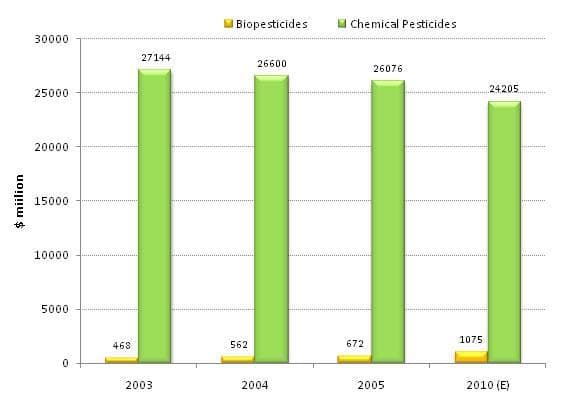
The global pesticide market was valued at approximately $40 billion in 2008, rising to nearly $43 billion in 2009, with projections of reaching $51 billion by 2014 at a compound annual growth rate (CAGR) of 3.6%. Within this market, biopesticides represent a much smaller but far faster-growing segment — expected to grow from $1.6 billion in 2009 to $3.3 billion in 2014 at a CAGR of 15.6%, more than four times the growth rate of synthetic pesticides. In terms of usage, orchards account for the largest share (55%) of global biopesticide application, with North America consuming the largest regional share (40%), followed by Europe and Oceania at 20% each.
The Indian Scenario
In India, biopesticides represented only about 2.89% of the overall pesticide market as of 2005, with an expected annual growth rate of roughly 2.3%. Only 13 types of biopesticides had been registered under the Insecticide Act, 1968, with neem-based products, Bacillus thuringiensis, NPV, and Trichoderma forming the major biopesticides produced and used domestically. Consumption rose from 219 metric tonnes in 1996–97 to 683 metric tonnes in 2000–01, with roughly 85% of that volume being neem-based products, even as chemical pesticide consumption fell over the same period.
Institutional support has grown alongside this: the Indian Council of Agricultural Research (ICAR) operates 31 bio-control production facilities, with the Department of Biotechnology supporting another 22, and the National Centre for Integrated Pest Management (NCIPM) oversees around 38 State Bio-control Labs engaged in producing and distributing natural predators and parasites to farmers. The National Farmer Policy, 2007 explicitly recommended treating biopesticides at par with chemical pesticides in terms of support and promotion.
Research Output and Patent Trends
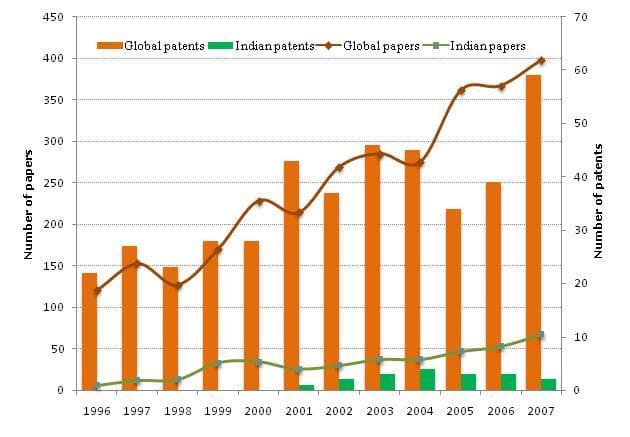
Research and development activity offers another lens on the sector's trajectory. Indian publications on biopesticides accounted for 443 papers — 13.23% of the 3,348 global papers in the field up to 2007 — though India's share of related patents stood at just 3.55% of global holdings, with only 19 patents secured. The average annual growth rate of global publications during the period was 51.1%, compared to 37.4% for India, indicating that while Indian research is expanding, global output is expanding considerably faster.
Microbial and Biochemical Classes
Biopesticides broadly fall into microbial biopesticides — bacteria, fungi, viruses, protozoa, and nematodes — and biochemical biopesticides such as plant extracts and insect growth regulators. Bacillus thuringiensis (Bt) remains the most widely used biopesticide worldwide, effective against caterpillar pests, mosquito and black fly larvae, and certain beetles depending on the subspecies used. Entomopathogenic fungi such as Beauveria bassiana and Metarhizium anisopliae, baculoviruses like the granulovirus of the codling moth (CpGV), and entomopathogenic nematodes in the genera Steinernema and Heterorhabditis round out the microbial toolkit, each occupying a specific ecological niche in pest suppression.
Role in Integrated Pest Management
The changing pest scenario, adaptive resistance, and secondary pest outbreaks have made it clear that insecticidal admixtures and combinations alone cannot resolve the problem of chemical resistance. Increased chemicalisation has eroded both economic and ecological sustainability, making the use of botanicals, biopesticides, and bio-control agents essential to managing pests and diseases in an eco-friendly way. Because biopesticides suppress rather than eliminate pest populations, they leave surviving individuals vulnerable to natural enemies — reinforcing rather than undermining the broader IPM system.
Conclusion
Biopesticides are a set of tools that can help farmers transition away from highly toxic conventional pesticides toward truly sustainable agriculture. They are not a complete solution in themselves — sustainable agriculture is a broad and deep field — but they are a significant part of it. Being effective, often quickly biodegradable, largely free of residue problems, and safe for non-target organisms and humans, biopesticides are an important component of IPM. Continued research into greater efficacy, persistence, and host specificity, alongside molecular tools to engineer novel agents and formulations with improved storage stability, will determine how large a role biopesticides ultimately play in the future of pest management.